
Articles
Parts, products and call-out charges you put on an invoice with one click — including how Schedulinq works out the kilometres for you.
An appointment lands on the invoice by itself. Everything you charge besides it — a filter, a thermostat, the drive to the customer — you used to type out every time. Articles are those loose lines, recorded once: a name, a price, a VAT rate. On the invoice you type the first letters and the line is there.
There are two kinds. A plain article has a price per piece. A travel cost does not: its amount depends on the distance to the customer, and Schedulinq works that out for you.
In short
- Go to Sales → Articles and click New article.
- Give it a code and a name — the name is what the customer reads on the invoice.
- Choose the kind: an article with a unit price, or a travel cost by distance.
- Fill in the price and click Create.
- On an invoice, type the name into an empty line and pick the article from the list.
The overview
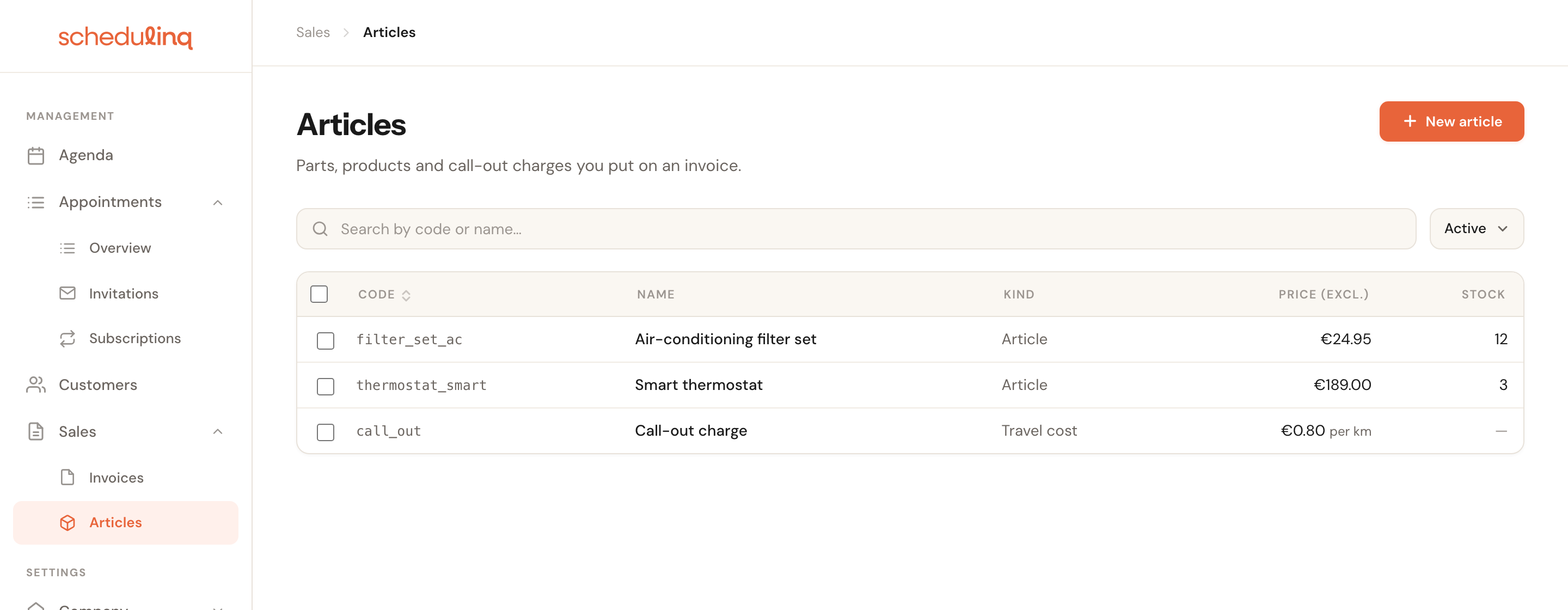
The Kind column says whether a line bills per piece or per kilometre; a travel cost shows per km after its price.
You search by code or name. The filter on the right is set to Active; switch it to Deleted to find articles you have removed, or to All. Click a row to open the article.
Creating an article
Click New article
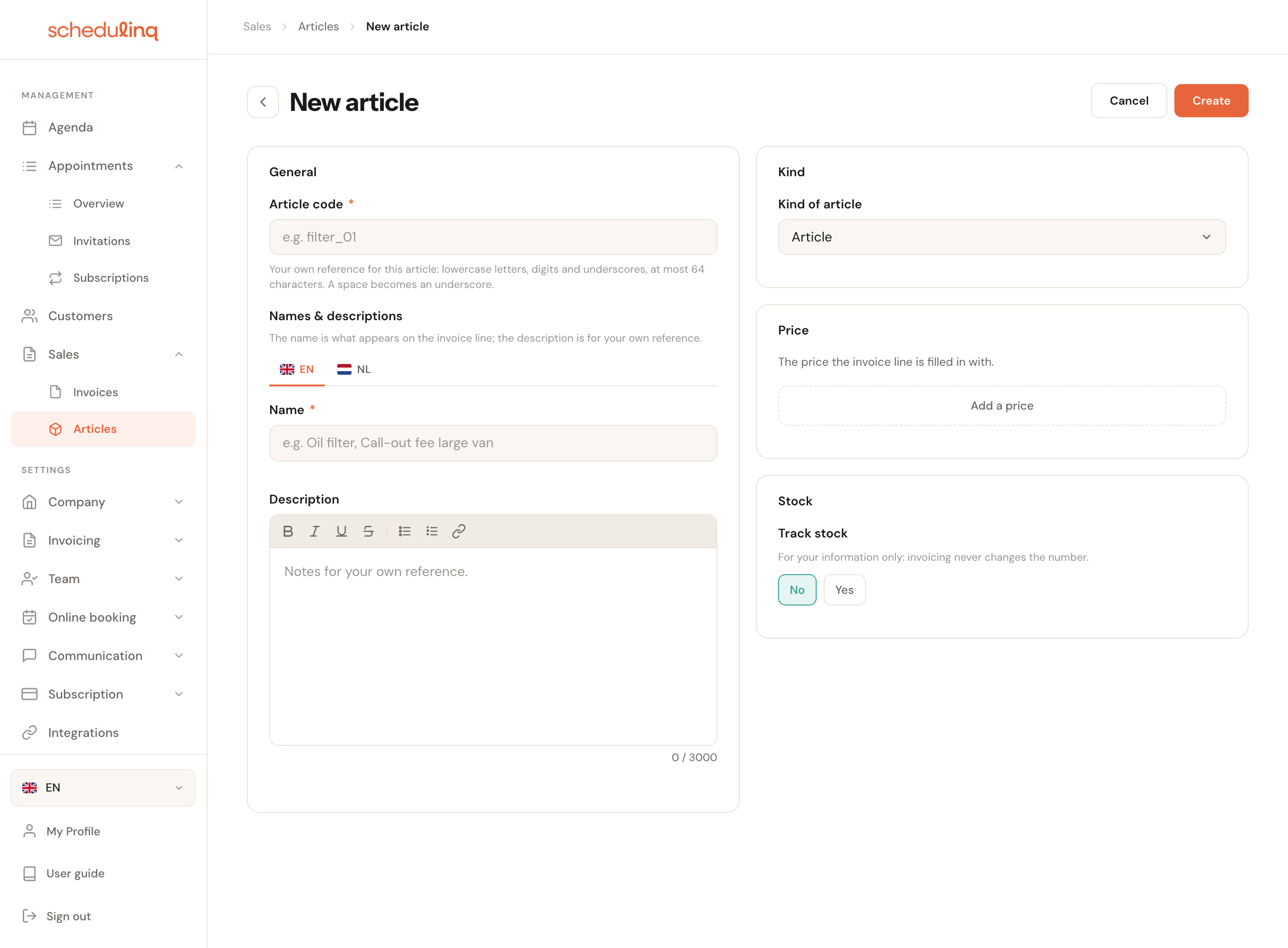
Top right of the overview. You land on an empty form with what the article is on the left and what it costs on the right.
Give it a code and a name
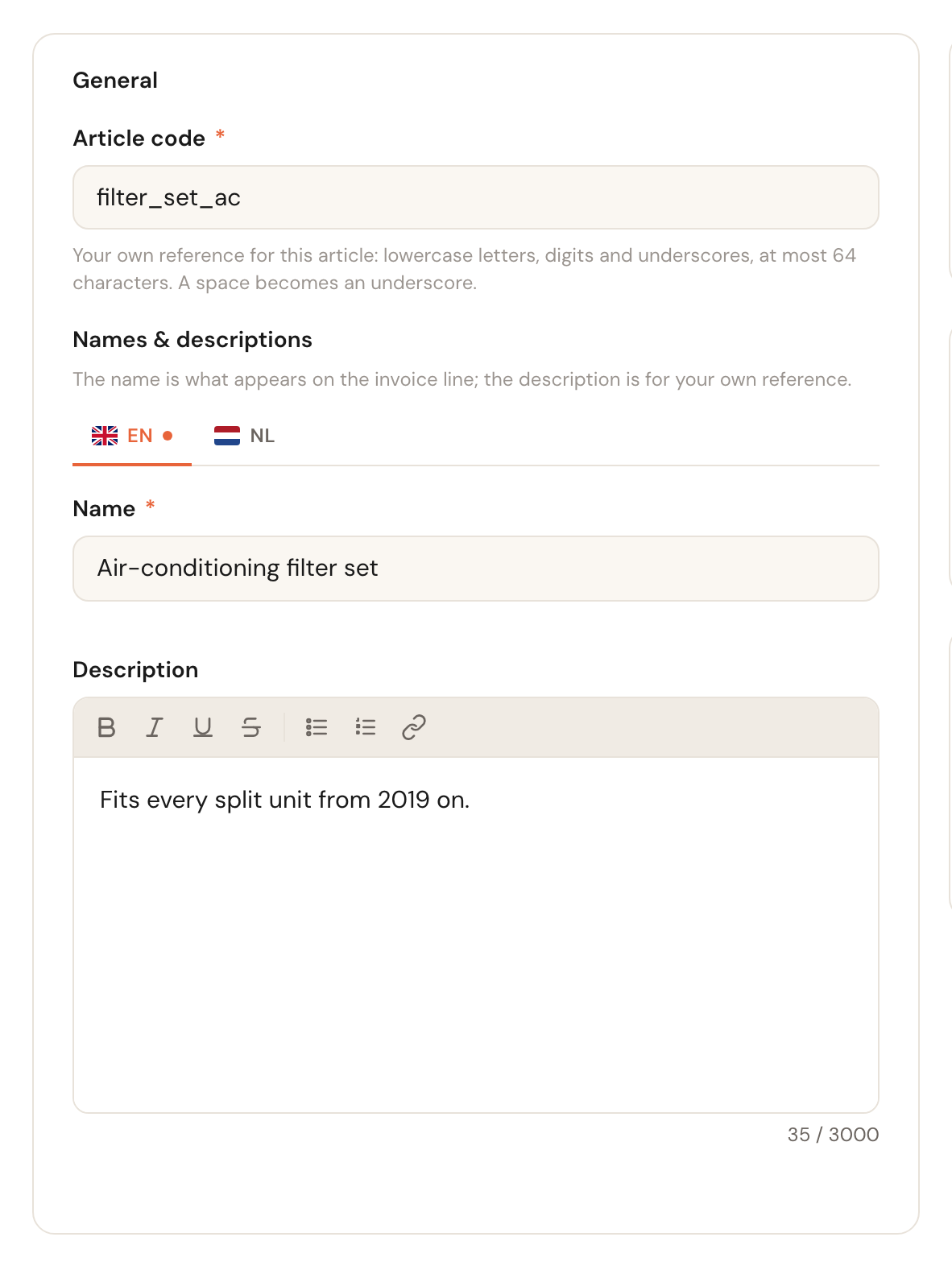
The article code is your own reference; the name is what goes on the invoice line. If you work in several languages, you fill in a name per language.
Choose the kind
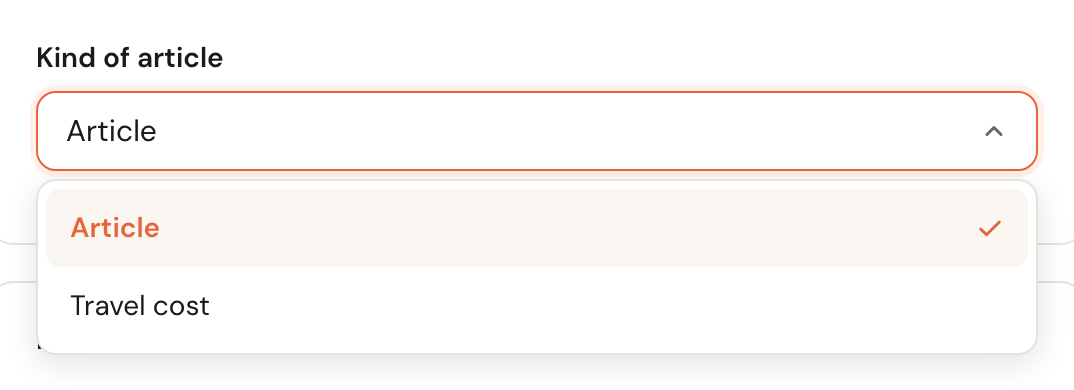
Under Kind of article you pick Article or Travel cost. A travel cost brings extra fields; they are covered further down in Travel cost.
Fill in the price
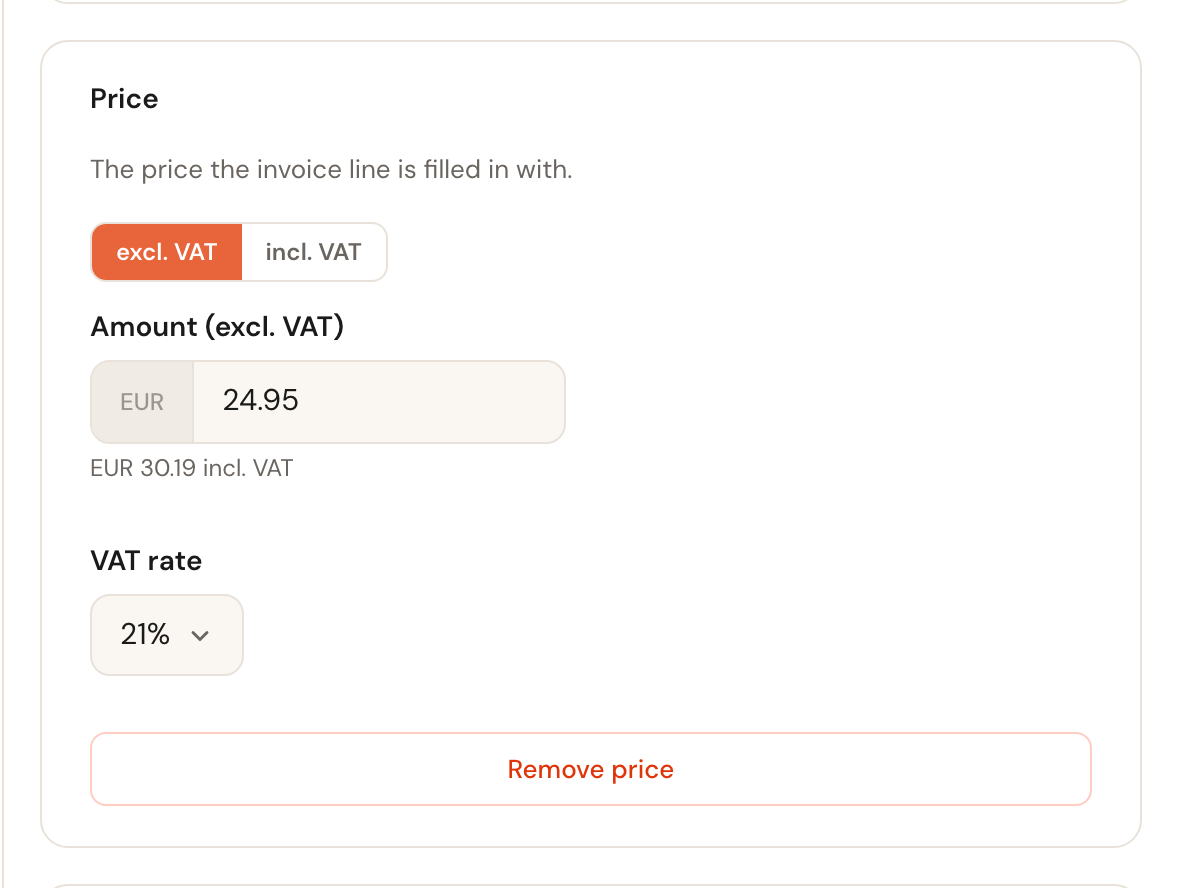
Click Add a price. You choose whether you type the amount including or excluding VAT, and the VAT rate; Schedulinq works out the other amount.
Track the stock if you want to
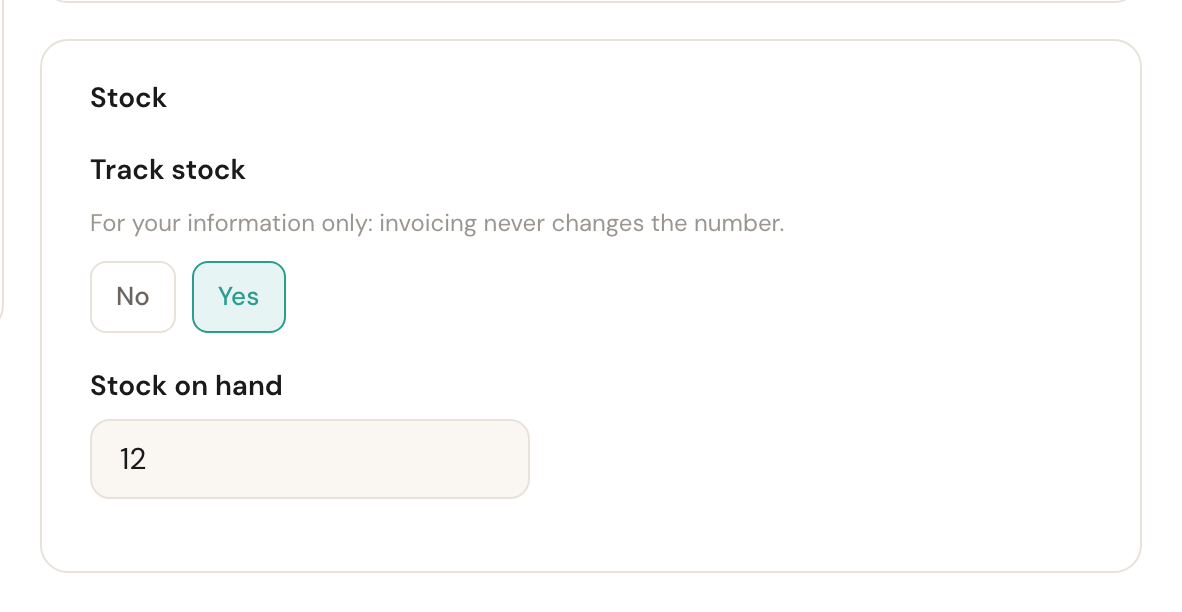
Set Track stock to Yes and fill in the number. This is for your information only — see Stock for what it does and does not do.
Click Create
The article is in the overview straight away, and in the invoice editor's search list.
The General card
Article code
RequiredUniqueYour own reference: lowercase letters, digits and underscores, at most 64 characters. A space becomes an underscore by itself.
The code is what you search on — in the overview and in the invoice editor. If you use the numbers from your own stockroom or your supplier, you type the same thing on the invoice as on the delivery note. Unlike an appointment type's identifier, you may still change the code later: nothing else hangs off it.
Name and description
Name required in your first languagePer languageThe name goes on the invoice line. The description is for you and never leaves the building.
The customer only reads the name, so write it the way you want it on the invoice: Air-conditioning filter set, not FLT-AC-01. If you have set up several languages, a customer gets the name in their own language — and otherwise the one in your default language. The description is the place for what you want to remember: which supplier, which type fits what.
The Kind card
Kind of article
Article or Travel costAn article bills per piece. A travel cost bills by distance to the customer.
The difference is in what the price means. For an article it is an amount per piece, multiplied by the quantity on the invoice. For a travel cost it is an amount per kilometre, and the quantity — the kilometres — is filled in by Schedulinq. That is why the other cards change the moment you switch here.
The Price card
Amount and VAT rate
The amount the invoice line is filled in with, plus the VAT rate that goes with it. You type including or excluding VAT; the other figure appears right underneath.
On the invoice Schedulinq always calculates from the amount excluding VAT, so that is what lands on the line — even if you typed the price including VAT here. If you change the price later, the new price applies to new lines. Invoices that already carry the article keep their amount: a line is a copy of the article at that moment, not a reference to it.
The Stock card
Track stock
Default: NoFor information onlyOn Yes, a Stock on hand field appears. The number shows as a column in the overview.
The number is a note, not bookkeeping: an invoice never changes the stock. You raise it yourself when a box comes in and lower it when you count. What it buys you is one place where you see what is still on the shelf, next to the price you sell it for. A negative number turns red.
Travel cost: an article that bills by distance
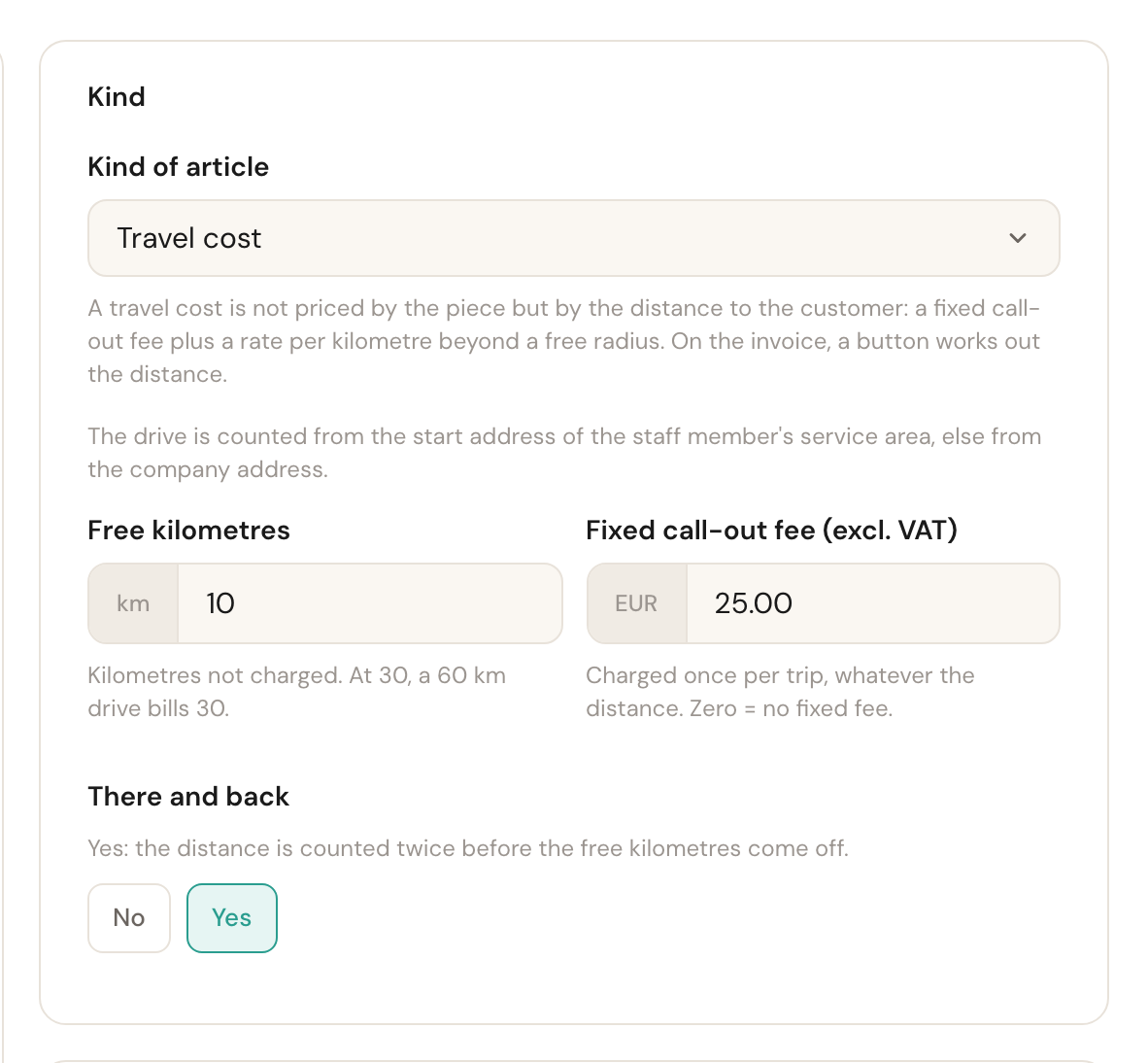
Choose Travel cost under Kind of article and the form changes. Instead of a price per piece you record three things: how many kilometres are free, whether a fixed fee per trip comes on top, and whether you count the way back too. The Price card is now called Rate per kilometre.
Free kilometres
Default: 0The kilometres you do not charge. Anything above them is billed.
This lets you charge customers round the corner nothing and customers further out something — without two articles. With 10 here and a 32-kilometre drive, 22 go on the invoice.
Fixed call-out fee (excl. VAT)
Default: 0One amount per trip, whatever the distance. Zero means: no fixed fee.
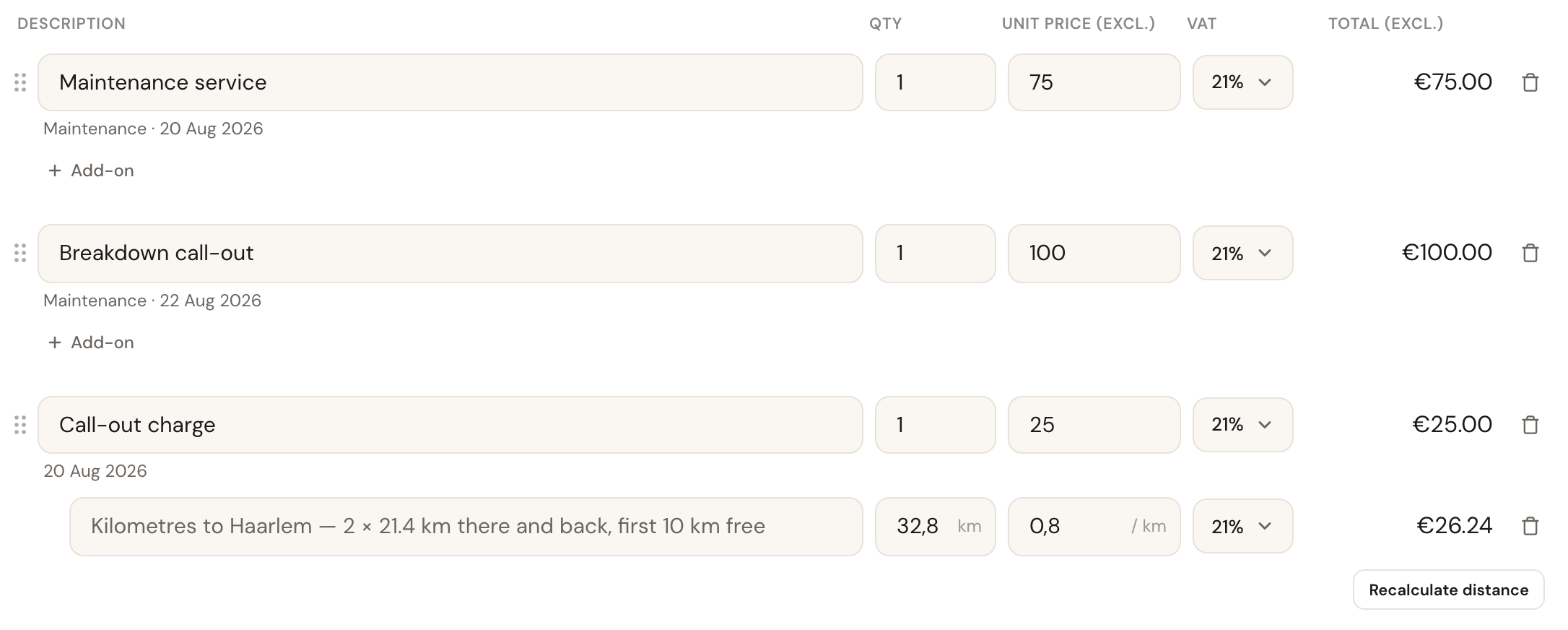
The fixed fee becomes its own line on the invoice, carrying the article's name; the kilometres follow as a second line underneath. That way the customer sees what the call-out costs and what the distance costs. If you only work with a fixed fee, leave the rate per kilometre at zero: then there is never a kilometres line.
There and back
No or YesOn Yes, the distance counts twice before the free kilometres come off.
With 21.4 kilometres one way and 10 free kilometres, No bills 11.4 kilometres and Yes bills 32.8. The customer sees which of the two you chose on the invoice line: 2 × 21.4 km there and back is spelled out.
Rate per kilometre
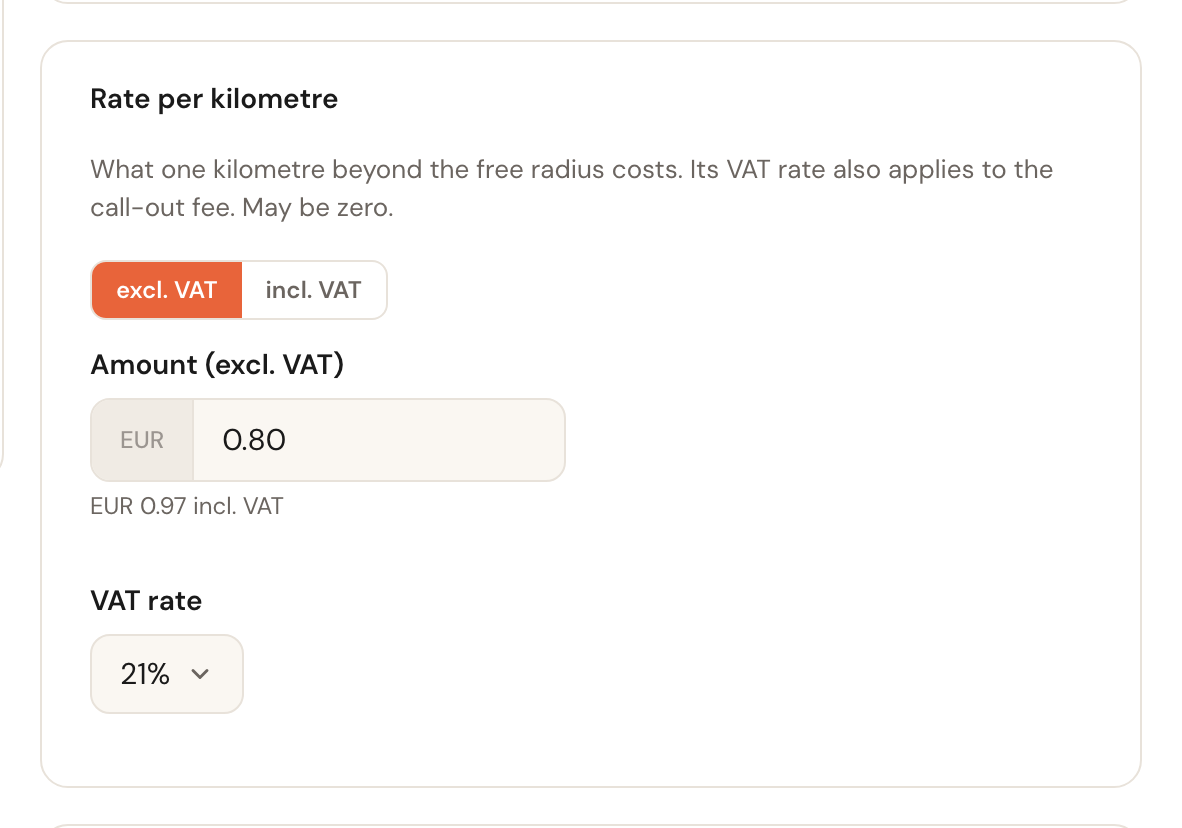
Required for a travel costMay be € 0.00What one kilometre beyond the free radius costs, with its VAT rate.
The VAT rate you choose here also applies to the fixed call-out fee — which is why this card is required even if you only charge a fixed fee and set the rate to zero.
On the invoice
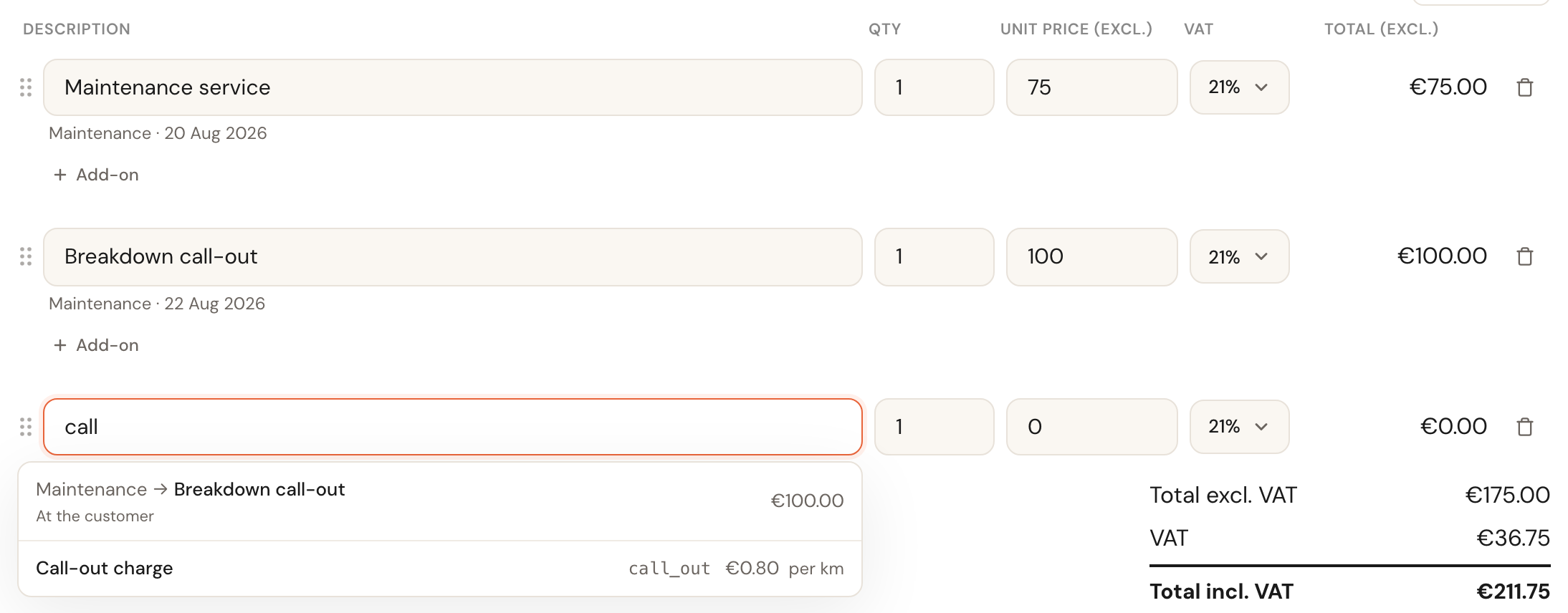
You put an article on an invoice by typing its name or code into an empty line; the invoice editor searches as you type. How that works exactly is in Create an invoice. A travel cost deserves its own explanation here, because something happens the moment you pick it.
Pick the customer first
The distance is worked out to the customer's address, or to the address of the appointment you are invoicing. Without a customer Schedulinq cannot calculate, and says so.
Type the name into an empty line and pick the article
In the list you recognise a travel cost by per km after its rate. Pick it and the line briefly reads Working out the distance….
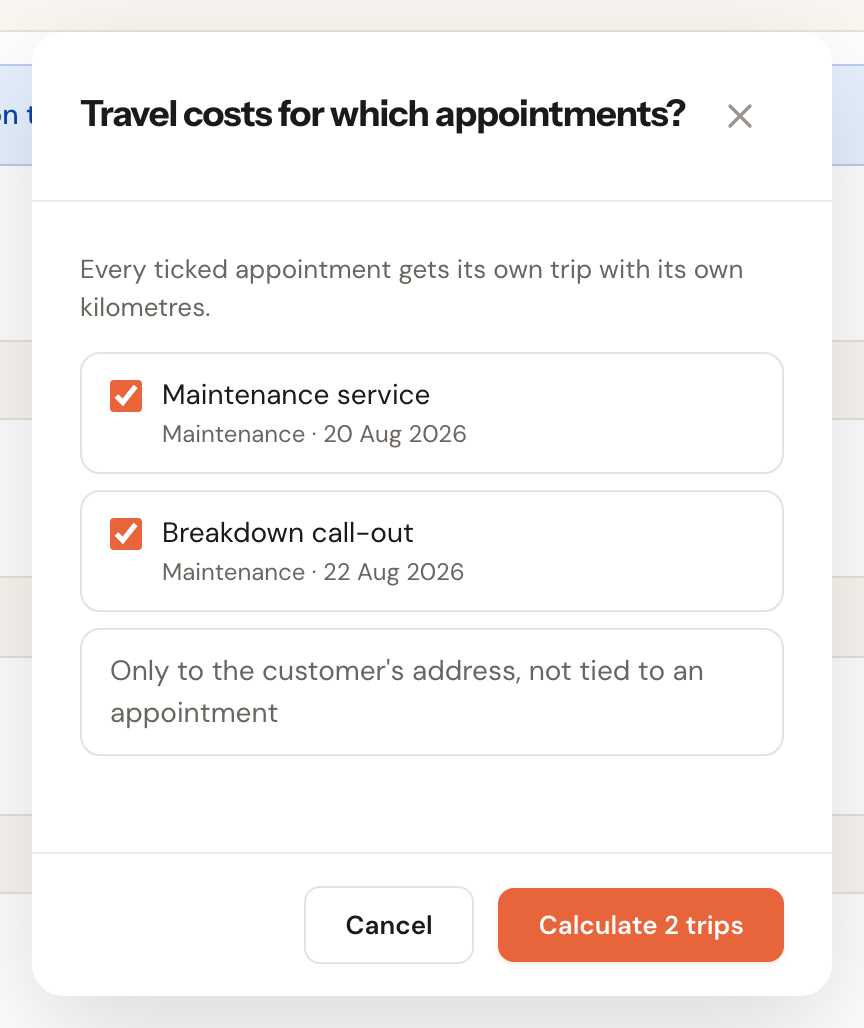
Choose where to drive to — only when needed
With one appointment on the invoice, Schedulinq drives to that appointment's address. With none, to the customer's address. Only with several appointments do you get a question: which visits do you want to charge travel for? Every ticked visit becomes its own trip with its own kilometres.
Check the lines
The result is two lines together: the fixed call-out fee, and underneath it the kilometres with the arithmetic in the description. The quantity reads km, the unit price / km.
Deleting and restoring an article
Open the article and choose Actions → Delete, or tick several articles in the overview. The article disappears from the invoice editor's search list; invoices that already carry it keep their lines.
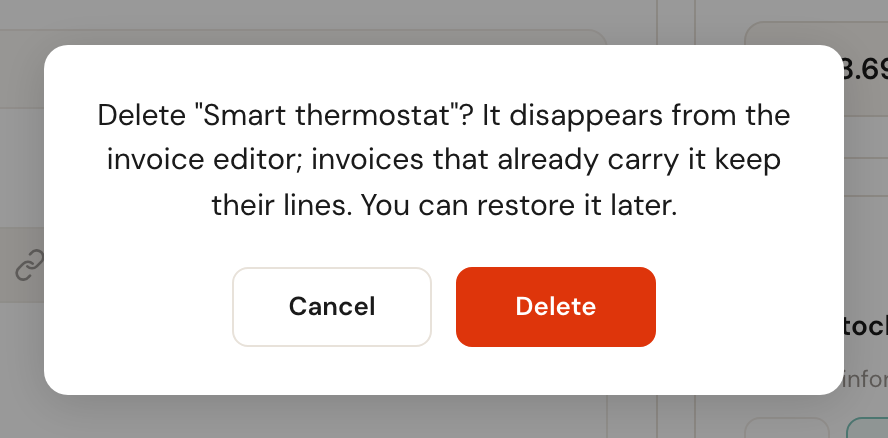
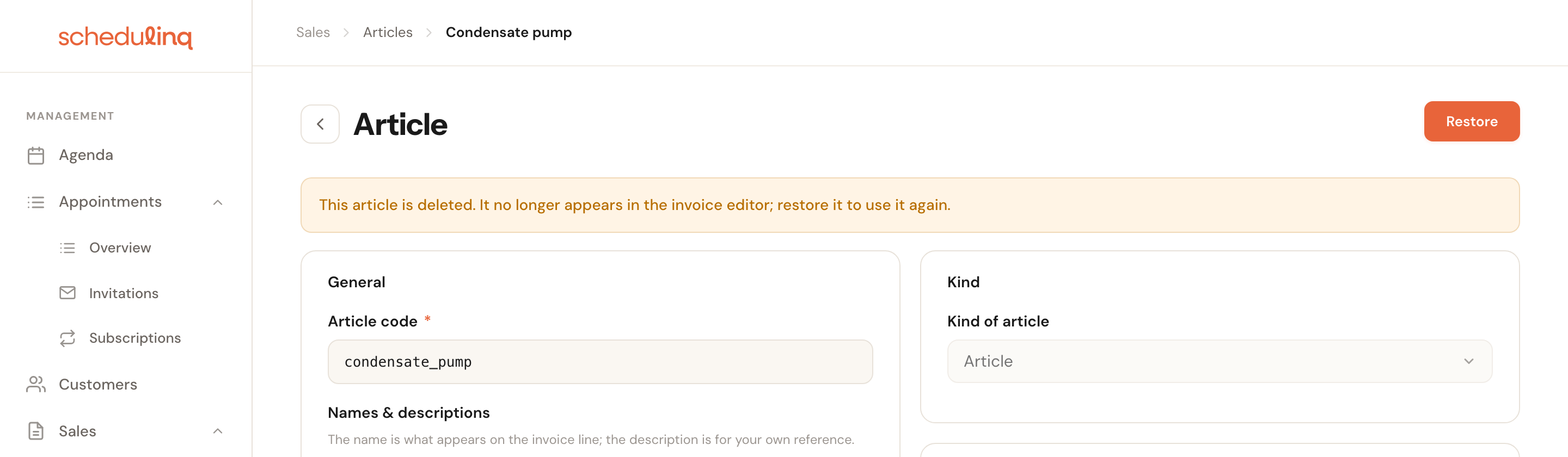
Deleting is reversible. Set the filter in the overview to Deleted, open the article and click Restore. It is back in the search list, with the same code, name and price.
Frequently asked questions
I do not see Articles in the menu. The Articles area has its own permissions. If your role existed before articles did, it stays off until an administrator switches it on under Team → Roles. Putting articles on an invoice already works with the Sales invoices permission — only managing the catalogue needs the new area.
I changed a price, but the invoice still shows the old amount. Correct: a line is a copy of the article at the moment you added it. To get the new price onto a draft, remove the line and pick the article again.
Can I link an article to an appointment type so it comes along automatically? No. Something that belongs to a service and may be booked online with it is an add-on. An article is for what you only know at invoice time: material you used, or the drive.
The stock is wrong. Invoices never change the stock; the number only changes when you change it. Think of it as a tally, not a warehouse system.
Why does Schedulinq count the distance from a different address than I expect? The drive starts where the scheduling algorithm starts it too: at the start address of the service area of the staff member on the appointment, and otherwise at your company address. If you want a different departure point, change the service area's start address.